Less than three months to go. From 1 January 2027, any company in Spain that issues invoices with software has to use a system that meets the invoicing software regulation, better known as Verifactu. The self-employed have until 1 July 2027. In our work with WooCommerce shops, Odoo installations and custom software, one question keeps coming up: does a website that sells and generates invoices fall under the rule? In most cases it does. Below we explain what to check, in which order, and when there is nothing to change.
What the rule says and which dates apply
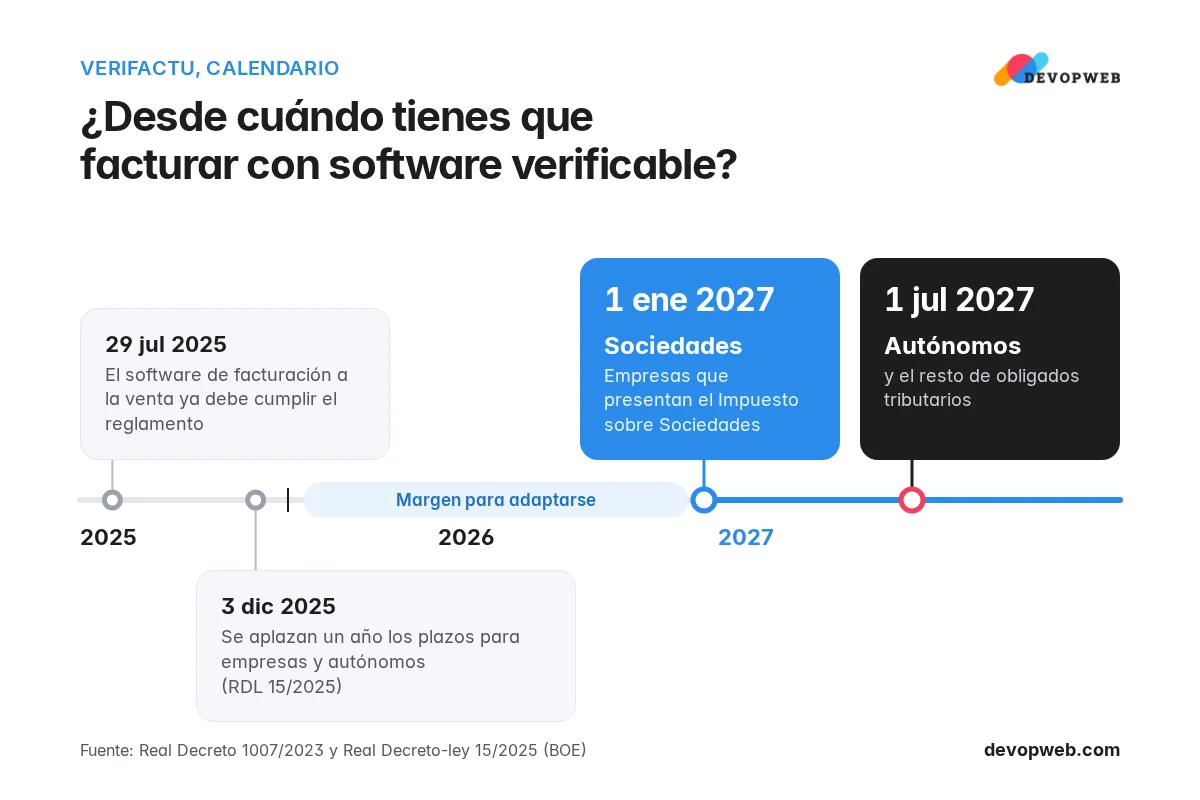
The regulation was approved by Royal Decree 1007/2023, and its technical specifications are in Order HAC/1177/2024. The dates have moved twice. The latest change came with Royal Decree-law 15/2025 of 2 December, which the Spanish parliament ratified on 11 December 2025. The deadlines now are:
- Companies paying Spanish corporate income tax: compliant systems before 1 January 2027.
- Everyone else in scope, including self-employed people taxed on business income: before 1 July 2027.
- Makers and resellers of invoicing software: since 29 July 2025 they may only offer compliant products, according to the Spanish Tax Agency FAQ.
There are two ways to comply. In VERI*FACTU mode, the software sends each invoice record to the Tax Agency at the moment the invoice is issued. In the non-verifiable mode, the system keeps the records itself and needs extra controls, including an event log, for the whole limitation period. The Tax Agency itself says that sending records online makes those more complex and costly measures unnecessary and frees the user from keeping the records safe. In both modes every invoice carries a QR code that the customer can use to check it with the tax authority.
Who is affected and who is not
The Tax Agency sums it up as the rule of four noes. The regulation applies to you if you are established in Spain, you issue invoices (simplified invoices and till receipts count too) and in addition:
- You do not invoice purely by hand, which means you use some software to issue invoices.
- You are not in the Immediate Supply of Information system (SII), whether by obligation or by choice.
- Your tax address is not in the Basque Country or Navarre, which apply their own regional rules.
- You do not hold a Tax Agency ruling that exempts you.
The SII point settles most doubts: businesses that keep their VAT books through the SII are outside the regulation entirely, as article 3.3 of Royal Decree 1007/2023 states.
Two details we see often. Writing invoices in Word or a spreadsheet does not bring you into scope if the file is only used to type, print and store them; once a spreadsheet runs a macro that builds the register of issued invoices, it counts as an invoicing system. And retailers under the equivalence surcharge scheme are, in general, not required to issue invoices, so the regulation does not apply to them either, unless they do issue invoices with software, for example to another business. Be careful with mixing: if you use software for any invoice, the Tax Agency expects all your invoicing to be done by computer.
WooCommerce shops: the invoice plugin counts
The Tax Agency is clear that online shops are affected exactly like physical ones. What matters is which system issues the invoice, and we see three situations.
The shop does not issue invoices. Orders go to Odoo, to an invoicing tool or to your accountant, and the invoice is created there. The website does not need to change; that other system is the one that must comply. If your accountant issues invoices on your behalf with their software, they generate the record, although the responsibility stays with you.
The shop issues invoices through a plugin. Then the plugin is an invoicing system. Its maker has to sign a statement of compliance (declaración responsable) and make it available inside the product. Since makers may now only sell compliant versions, if your plugin still shows no such statement and its documentation does not mention Verifactu, we would take that as a sign to replace it.
The plugin has been modified. For the Tax Agency, any custom development on another maker's invoicing software is a modification that the original statement does not cover. Whoever made the changes has to sign their own. The same goes for a shop and an ERP that issue invoices separately with no link between them: they are two systems and both must comply.
If your shop is in this last group, it is worth reviewing it properly as part of your online shop maintenance.
Odoo and custom software
Odoo ships the Spain - Veri*Factu module (l10n_es_edi_verifactu) in its Community code, under the LGPL-3 licence, from version 17 onwards; the official code for version 16 does not include it. The Odoo documentation explains that the module starts in test mode: you upload a certificate and switch off the test environment to send to production. Odoo publishes its statement of compliance on the same page. If you run your own modules that touch invoices, the plugin rule applies: whoever wrote them answers for them.
With custom software the rule is simple. If a company built its own invoicing program for internal use, the company itself must certify it with a statement of compliance. With open source code, the statement is signed by whoever programs or integrates the code.
Leaving this to the last month is a bad idea. Using a non-compliant system after the deadline carries a fixed fine of 50,000 euros per financial year under article 201 bis of the Spanish General Tax Law. The Tax Agency states that it will first assess the conduct and responsibility of the business, but the risk is real.
Seven steps to take now
- Confirm your date: companies 1 January 2027, self-employed 1 July 2027. If you are in the SII or taxed in the Basque Country or Navarre, the list ends here.
- List everything that issues invoices or simplified invoices: the website, the till in your physical shop, the ERP, the app, your accountant's software and any spreadsheets with macros.
- Keep a single invoicing point wherever you can. Every system that issues invoices is one more system to certify and maintain.
- Ask each provider for the statement of compliance for the version you use, and check that it is visible inside the software.
- Review custom changes to invoicing plugins, modules or programs, and agree who signs their statement.
- Choose the mode. We recommend VERI*FACTU for almost every small and medium business, because of what it saves in record keeping and controls.
- Test before the deadline. The Tax Agency services have been live since 23 April 2025 and the agency encourages early adoption; until your mandatory date you can try a compliant system and go back to the old one if something fails.
When you can leave things as they are
You do not need to change anything if your website is a catalogue or only takes orders or bookings, and the invoices come from another system that is already compliant. The same applies if you are in the SII, if your tax address is in the Basque Country or Navarre, if you invoice by hand or with Word and Excel without macros that build tax registers, or if you are under the equivalence surcharge scheme and only sell to consumers without issuing invoices. For businesses that issue few invoices, the Tax Agency also offers a free invoicing app on its website.
Our recommendation
For a WooCommerce shop that currently invoices with a modified plugin, or one without a statement of compliance, we do not recommend building your own Verifactu module. Doing so turns you into a software producer: you would have to sign the statement and keep it current with every release. Our advice is to let one compliant system issue all invoices (Odoo if you already use it, or an invoicing tool with a published statement) and have the shop pass orders to it through an integration between shop and ERP, in VERI*FACTU mode. If your plugin is already compliant and nobody has modified it, updating it and checking the statement is enough. It is also a good moment to remove plugins you no longer use and that only add weight, something we cover in website optimisation.
This article covers the rules from the technical side; for the tax details of your own case, talk to your tax adviser.
Not sure which of your systems issue invoices?
Tell us how your shop, ERP and invoicing tools are connected today. We will tell you what has to change before your deadline and how to bring invoicing into one system.