On 5 October, Spain's Official State Gazette published Order HAC/1028/2026, which regulates the Tax Agency's public e-invoicing platform. It came into force the next day, and with it the countdown to mandatory electronic invoicing between businesses and professionals began. For most SMEs and self-employed people the date is 6 October 2028. That sounds far away, but the change touches the software you invoice with, your ERP, your online shop if it sells to other businesses, and the way you record payments to suppliers. Below we explain what was approved, how it differs from Verifactu and what is worth preparing now.
What was approved and which dates apply
The obligation comes from Law 18/2022 on business creation and growth, which amended article 2 bis of Law 56/2007. The technical detail is in Royal Decree 238/2026 of 25 March, which kept the deadlines on hold until the Ministry of Finance approved the order for the public platform. That order is the one published on 5 October, and the timeline, according to the Spanish Tax Agency, is now:
- Businesses and professionals with a turnover above 8 million euros in the previous year: issue and receive e-invoices, and report invoice status and payment, from 6 October 2027.
- All other businesses and professionals: issue and receive e-invoices from 6 October 2028.
- Companies and other legal entities below that 8 million: report status and payment also from 6 October 2028.
- Self-employed individuals and entities under the income attribution regime: report status and payment from 6 October 2029.
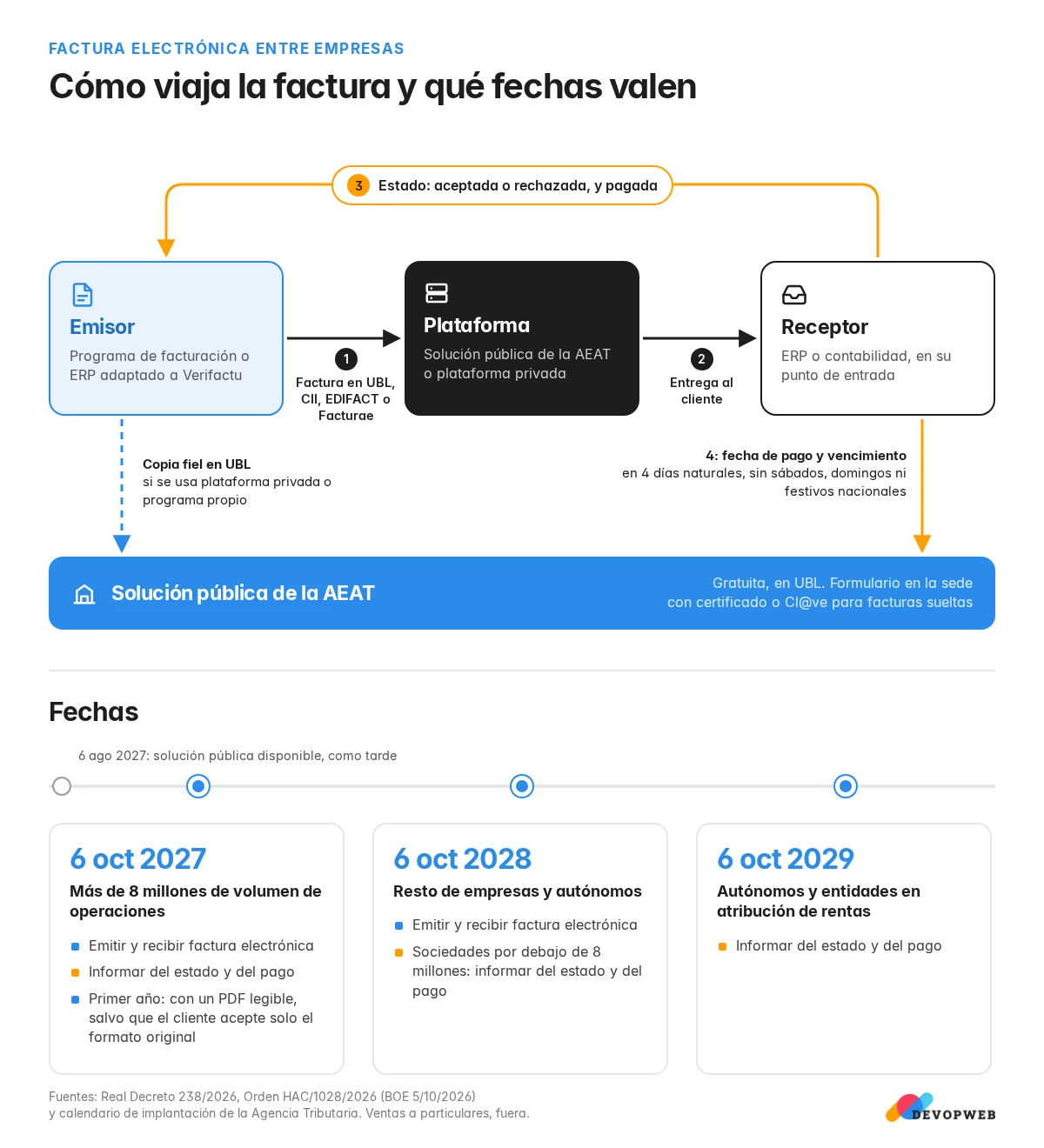
During their first year under the rule, large companies must send a readable PDF with each e-invoice, unless the customer agrees to receive it in its original format only. The royal decree also requires the public platform to be available at least two months before the first date, which means by 6 August 2027 at the latest.
How it differs from Verifactu
These are two separate rules that overlap. Verifactu regulates the software used to issue any invoice, including invoices to consumers, so that invoicing records cannot be altered. Mandatory e-invoicing regulates the format and delivery of invoices between businesses: a structured file that the customer's software reads without anyone retyping it, instead of a PDF. The two meet at one point, according to the Spanish Tax Agency: a mandatory e-invoice has to come from an invoicing system that complies with Verifactu. If you are already changing or updating your invoicing software for Verifactu this year, ask your provider for both at once.
Who is affected and which invoices are covered
The obligation applies, according to the Spanish Tax Agency's FAQ on who is covered, when the transaction requires an invoice, it takes place within a business or professional activity, and the customer is a business or professional established in Spain. Outside the scope:
- Sales to consumers.
- Transactions with businesses not established in Spain, including intra-EU ones.
- Simplified invoices (till receipts), except qualified simplified invoices, which carry the customer's details.
- Transactions that do not need an invoice and those with a Tax Agency authorisation not to issue one.
For an online shop the line is clear. If it only sells to consumers, this rule does not change its sales invoices (Verifactu does). If it also sells to businesses and the self-employed, for example with trade prices or a tax ID field at checkout, every invoice to a customer established in Spain will have to be electronic and structured. And one part affects everyone: your Spanish suppliers will also send you their invoices in this format, so receiving invoices and reporting payments applies to you even if you never sell to a business.
How invoices travel: public platform or private provider
There are two routes and they can be combined. The first is the Tax Agency's public platform, free of charge and aimed mainly at SMEs and the self-employed. The second is private exchange platforms, which must connect with each other without charging for it. What you need to know:
- Accepted formats: UBL, CII, EDIFACT and Facturae, all based on the European standard EN 16931. The public platform works in UBL.
- If you invoice through a private platform or your own software, it has to send a true copy of each invoice, in UBL, to the public platform at the same time.
- For occasional invoices, the Tax Agency will offer a free form on its website, with access by digital certificate or Cl@ve.
- If you receive invoices through a private platform, you must publish your entry point in your communications with suppliers and on your website; otherwise you are deemed to receive them through the public platform.
- A customer cannot force you to use a specific platform or invoicing provider.
The new part: reporting payments
This is the change that will take the most work, because it alters how payments are recorded. Whoever receives an invoice has to tell the issuer whether they accept or reject it and when they pay it in full. They also have to report to the public platform the date of full payment and the due date, within four calendar days not counting Saturdays, Sundays and national holidays. If there is no rejection, the invoice is deemed accepted. The aim, according to the Tax Agency's general guidance, is to fight late payment and measure real payment terms between businesses. With this data, the Tax Agency will send each year the information used to list the companies that break the legal payment terms.
In practice, someone in your company will have to record the actual date of each supplier payment and send it. With ten invoices a month this can be done by hand in the form; with hundreds, it has to come out of the ERP or accounting software automatically. For online shops there is a useful detail in article 7.4 of the order: if the invoice already shows a payment date on or before its issue date, matching the date of the transaction, the payment report counts as done. An order paid by card at checkout fits this case, as long as the invoice says so, and your business customer is spared one task.
What to check in Odoo, WooCommerce and other software
Odoo's Community code includes the module account_edi_ubl_cii, which exports and imports invoices in UBL and CII. It is a good base, but the exact specifications for the public platform are published by the Tax Agency on its website, and the connection to it will have to be checked for each version. In WooCommerce, if your invoice plugin only produces PDFs, that is not enough: a PDF is a voluntary electronic invoice with no structure. These are the steps we recommend:
- Work out what share of your sales goes to businesses and professionals established in Spain. That share is what will need e-invoices.
- List how supplier invoices reach you today (email, portals, paper) and who records the date they are paid.
- Ask your software provider whether it will produce UBL to the Tax Agency's specifications, send the true copy and comply with Verifactu.
- Choose the route: public platform, private platform or both. With few invoices, the free form may be enough.
- If your shop sells to businesses, check that checkout collects the tax ID and full billing details, and that the invoice shows the payment date.
- Connect the shop to the system that issues invoices, so business orders are not typed in twice.
Our recommendation
There is no need to rush, but there is no point deciding twice either. If you are replacing your invoicing software for Verifactu before 2027, choose one now that produces structured e-invoices and can report payments, because repeating the migration in 2028 is double work. For shops that sell to businesses, we recommend that invoices come from the ERP or invoicing software and that the shop passes orders to it through an integration between shop and ERP, rather than relying on a plugin that only produces PDFs. And if you sell to professionals from your website, review what registration and checkout ask for as part of your online shop maintenance.
This article covers the rules from the technical side; for the tax details of your own case, talk to your tax adviser.
Not sure how your invoices come in and go out today?
Tell us which programs issue and receive your invoices and how your shop is connected. We will tell you what has to change before your deadline and what is worth connecting now.