Do you know what the Kit Digital is?
If you run a small business in Spain, there is a good chance someone has called you about the Kit Digital lately. The sector expects a new call for applications in the coming weeks, so this is a good moment to understand what it is, how much it paid and what to check before you sign anything. Here it is in plain terms, with the official figures from previous calls.
The Kit Digital is a Spanish government grant programme, run by the public agency Red.es, that helps small businesses and the self-employed adopt digital solutions already available on the market: a website, an online shop, social media management, e-invoicing or cybersecurity, among others. The grant is called the bono digital, or digital voucher, and it never reaches your bank account as cash. It is used to pay a digitalising agent (agente digitalizador), a company registered with the programme that builds and sets up the solution for you. According to the official España Digital page, more than 860,000 grants had been awarded when applications closed.
Who it is for
According to Acelera pyme, the Red.es platform for the programme, the Kit Digital is aimed at small, medium-sized and micro businesses and the self-employed in any sector. What decides how much you can get is your number of employees, which places you in a band, or segment, as the programme calls it.
How much each band received
These were the maximum voucher amounts in the latest calls, according to the Acelera pyme digital solutions page:
- Segment I, 10 to fewer than 50 employees: 12,000 euros.
- Segment II, 3 to fewer than 10 employees: 6,000 euros.
- Segment III, 0 to fewer than 3 employees, self-employed included: 3,000 euros. In the first calls it was 2,000.
- Segment IV, medium-sized businesses with 50 to fewer than 100 employees: 25,000 euros.
- Segment V, 100 to fewer than 250 employees: 29,000 euros.
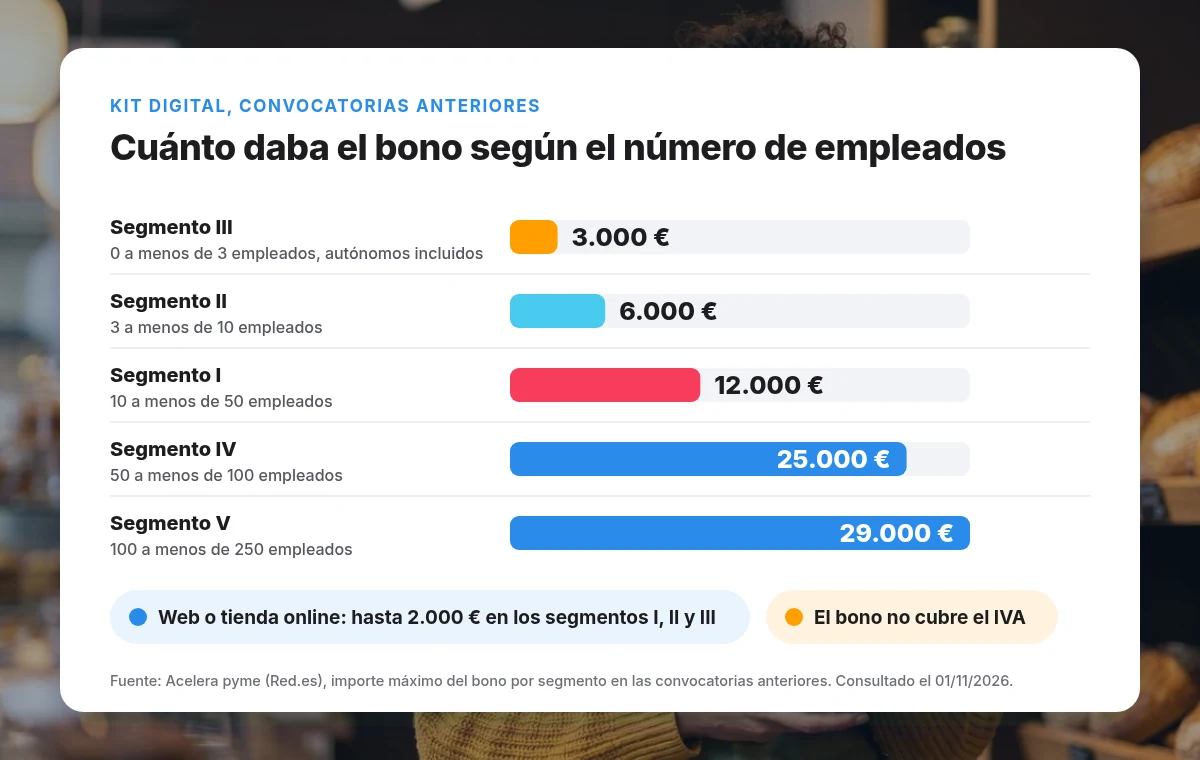
That amount is shared out across the solutions you choose, and each solution has its own cap.
How much it paid towards a website and an online shop
The website solution had a cap of 2,000 euros for segments I, II and III. Among other things, it included:
- The domain for at least twelve months, registered to your business.
- Hosting, the space where the website lives, for at least twelve months.
- A design of 3 to 5 pages, mobile friendly and accessible to level AA of the WCAG 2.1 guidelines.
- A content management system so you can change the text yourself, with training on how to use it.
- Basic search engine optimisation and maintenance if the site goes down.
The e-commerce solution had a cap of 2,000 euros for segments I, II and III, and 5,000 euros for segments IV and V. It covered building the shop, adding the product catalogue (the official page mentions at least 100 products, if you have that many), payment and shipping methods, mobile friendly design, accessibility, basic search optimisation and a system so you can run the shop yourself.

One point worth knowing from the start: the voucher does not cover VAT (IVA in Spain). The programme rules published in the BOE, Spain's official gazette, state that this tax is not eligible. For example, if the website solution costs 2,420 euros including VAT, the voucher covers the 2,000 euro net amount and the business pays the 420 euros of VAT. Your accountant can tell you whether you can reclaim it.
When will the new call open?
The sector expects a new call in the coming weeks. As of 1 November 2026, nothing has been published: the Acelera pyme page still says the programme's calls have ended, and no new call appears in the BOE. The last two calls that were still open closed at the end of October 2025.
What has been published is Order TDF/39/2026 of 26 January. It amends the rules and keeps them in force for any grants called until the programme's funds run out. It also allows leftover money to go to applications that once missed out because the budget had run dry.
When the call is published in the BOE, these are the conditions to check:
- Which segments can apply and how much each one gets.
- Which solutions are included and the cap for each, especially the website and the online shop.
- The minimum time the business must have been trading.
- The application window. Grants are awarded in order of arrival until the money runs out, so having everything ready matters.
- The deadline for signing with the digitalising agent, which the rules set at six months from the date the voucher is granted.
What to have ready
You can sort out almost everything before the call opens:
- Be registered with the Spanish Tax Agency (Hacienda) for the activity you actually carry out.
- Be up to date with payments to the Tax Agency and to Social Security.
- Know how many employees you have, because that sets your band.
- Register in the Acelera pyme private area and complete the digital self-assessment test, which is compulsory.
- Keep a list of any de minimis aid received in the last two tax years and the current one, because there is a ceiling.
- Have a digital certificate or, if someone else will apply for you, the voluntary representative form provided by Acelera pyme.
- Know what you want: website or shop, logo, text, photos and, if you sell online, the product list with prices.
With your content ready, the website goes live sooner and feels more like your business.
What to ask an agency before you sign
Many digitalising agents do good work. To choose with confidence, these questions help:
- Are you listed in the official catalogue of digitalising agents? It takes a couple of minutes to check.
- What exactly is included? Number of pages, languages, how many products you add and who supplies the text and photos.
- Which platform do you build it on, and will I be able to change the content on my own?
- How much VAT will I pay, and when?
- What will hosting, the domain and maintenance cost after the first year, VAT included? Is there a minimum term?
- Will you give me the administrator logins for the website and the domain?
- If I change provider one day, will you hand over a full copy of the website?
The most useful thing is to have the answers in writing in the agreement. A serious agency will do that without any fuss.
What happens when the included year ends
Hosting and the domain were included for at least twelve months. After that, the website still belongs to your business, but hosting and the domain renewal have to be paid for, with the same agency or another one.
The domain is yours: the rules say it belongs entirely to the business. The website was contracted by your business and paid for with your voucher, so it is normally yours as well, and it is worth having the agreement say so. We explain the difference between the two, with examples, in our article on what a domain and hosting are.
Before the renewal comes up, check three things: that the domain is in your business's name, that you have the logins and that you know how much is paid and when. With that, you can decide calmly whether to stay as you are, change hosting or improve the website without starting from scratch.
Our recommendation
There is no need to wait for the call to make progress. Get the requirements and your content ready and, once the call is in the BOE, compare the offers calmly. For questions about the programme, Red.es has a helpline for small businesses and the self-employed on 900 909 001.
Already have a website, from Kit Digital or not?
Ask for our free website review: we look at how your site is doing and within 24 hours we send you three specific recommendations by WhatsApp. Free and with no commitment.